The Strategic Imperative of Lean Discovery
The Startup Paradox: Velocity vs. Validity
In the high-stakes ecosystem of early-stage startups, the founding designer operates within a anomaly that defines the trajectory of the company. The imperative to ship product at breakneck speed conflicts directly with the necessity of validating that the product is worth building at all. Traditional user research methodologies, characterized by rigorous recruitment cycles, formal lab environments, and extended synthesis phases are structurally incompatible with the startup’s survival mechanism, which relies on burn rate management and rapid iteration. However, the absence of research is equally fatal. Building the wrong product with high efficiency is simply a faster route to failure.
The solution to this paradox is Guerrilla research. Often misunderstood as merely cheap or informal research, guerrilla methods represent a sophisticated operational discipline. It is the art of gathering high-fidelity signals regarding user behavior and intent within the constraints of zero budget and minimal time. For the founding designer, often a team of one, guerrilla research is not a compromise on quality but a strategic adaptation to the environment. It prioritizes sufficient confidence over statistical significance, enabling the product team to make reversible decisions quickly while reserving deeper inquiry for irreversible strategic bets.
The operational reality introduces new variables to this equation. The proliferation of AI-driven tools, the fragmentation of user communities into niche digital spaces like Slack and Discord, and the maturation of remote work have fundamentally altered the landscape of Intercept testing.
The founding designer must now be a hybrid operator, part anthropologist, part street hustler, and part data analyst, leveraging every tool to reduce the time-to-insight from weeks to hours.
The Psychology of the Team of One
The role of the founding designer is psychologically distinct from design roles in mature organizations. In a large enterprise, the designer is a crafter of interfaces. In a startup, the founding designer is the custodian of the user’s reality. This responsibility creates a significant cognitive load. The designer must constantly advocate for the user in a room full of engineers and founders who are often biased by their own vision and technical constraints.
Guerrilla research serves as a defensive mechanism against the echo chamber effect. Founders often fall in love with the solution rather than the problem. By injecting raw, unfiltered user feedback into the development cycle often through video clips or direct quotes, the designer shifts the internal debate from I think to The user did. This shift is crucial for preserving political capital.
When a designer says, “I don’t like this flow,” it is an opinion. When they say, “Three users failed to complete the signup in under 30 seconds,” it is a fact.
Furthermore, the founding designer must manage the Imposter Syndrome associated with informal research. There is a pervasive fear that without a PhD in Human-Computer Interaction or a formal lab, the research is invalid. However, the market does not care about p-values. It cares about product-market fit. The guerrilla mindset reframes research as risk mitigation. If a 15-minute cafe test reveals a catastrophic usability flaw, the methodology has justified its existence, regardless of academic rigor. The goal is not to publish a paper but to survive the next funding round.
The Three F’s Framework
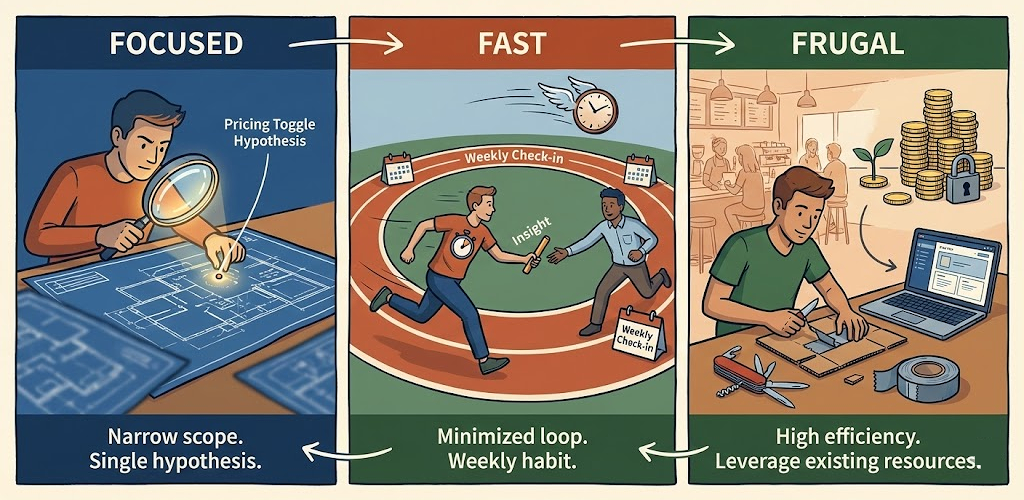
To operationalize guerrilla research effectively, the founding designer must adhere to the Three F’s framework, which governs the scope and execution of every study.
Focused
The scope of a guerrilla test must be ruthlessly narrow. In a formal usability study, one might test an entire end-to-end journey. In a guerrilla intercept, the designer has perhaps 10 minutes of the participant’s attention.
Therefore, the research must target a specific micro-interaction or a single hypothesis (e.g., “Do users understand the pricing toggle?” rather than “How do users feel about the brand?”).
Narrowing the scope reduces the cognitive load on the participant and the synthesis burden on the designer.
Fast
The loop from question to insight must be minimized. If planning a test takes longer than the sprint itself, the research will be abandoned.
The goal is continuous discovery, where research is a weekly habit rather than a quarterly event.
This requires pre-approved templates, a always-on recruitment mindset, and tools that automate the drudgery of scheduling and synthesis.
Frugal
In a startup, every dollar spent on recruitment incentives is a dollar not spent on runway.
Frugality signals to the founding team that the designer respects the company’s capital constraints. This involves leveraging public spaces, using internal networks, and utilizing free tier software tools.
However, frugality does not mean free. It means high efficiency. The cost is often the designer’s time, which must be weighed against the potential cost of engineering rework.
The Tactical Arsenal, Physical and Digital Intercepts
The Art of the Cafe Intercept
The quintessential image of guerrilla research is the cafe intercept. Despite the rise of remote tools, the physical intercept remains unmatched for high-bandwidth feedback on mobile experiences. It forces the designer to witness the user’s physical interaction with the device. The fat finger errors, the glare on the screen, the hesitation before a tap, and the environmental distractions that do not exist in a lab.
Environment Selection and Context Mapping
Success in physical intercepts relies heavily on Context Mapping. The designer must choose a location that aligns with the user persona. Testing a B2B productivity tool in a loud bar is futile. Testing it in a coffee shop near a business district or a co-working space (like WeWork lobbies) increases the probability of intercepting a relevant professional. Conversely, a fitness app should be tested near gyms or parks, and a shopping app in a mall food court.
The Approach Protocol
The most intimidating aspect of guerrilla research is the cold approach. To mitigate rejection, the designer should adopt a posture of low status and vulnerability.
- The Student Frame
Hi, I’m working on a project and trying to keep my teacher happy. Could you spare 3 minutes?. This invokes a helping instinct. - The Coffee Economy
Offering to buy a coffee or pastry is the standard currency of the cafe intercept. It is a low-cost incentive (approx. $5) that creates a social contract, obliging the participant to give thoughtful feedback for the duration of the drink. - The Wizard of Oz Mobile Test
In the early stages, code is rarely ready. The designer often uses clickable prototypes (Figma, Marvel or Banani) loaded onto a mobile device. The physical sensation of holding the phone is crucial. The designer should observe:
Thumb Zone Reach
Does the user struggle to reach the primary CTA
Loading Perception
Does the user tap repeatedly when the prototype lags (simulating load times)?
Distraction Recovery
When the barista calls a name, does the user remember what they were doing in the app? This tests the cognitive resilience of the UI.
Digital Guerrilla: The Hallway is Now Slack and Reddit
In a digital world, especially for B2B startups, the cafe has been replaced by digital communities. Slack groups, Discord servers, and Reddit threads serve as the new public squares for intercept testing. However, the rules of engagement are different; these spaces are guarded by moderators and social norms that punish overt marketing.
Slack and Discord Communities
For specialized personas (e.g., developers, designers, writers), Slack communities are goldmines.
- The Beta Ask
Instead of asking for feedback, the designer frames the request as exclusive access. I’m building a tool to solve. We are letting in a small group for beta access. DM me if interested. - The Problem Discussion
Post a question about the problem, not the solution. How do you currently handle? I’m finding X tool really frustrating. Those who reply with detailed rants are ideal candidates for an intercept interview.
Reddit Mining and Intercepts
Reddit offers anonymity, which encourages raw honesty. However, self-promotion is often banned.
- The Help, Don’t Sell Strategy
The designer should search for threads where users are already complaining about the problem the startup solves. - Protocol
Engage in the comments first to build karma. Then, DM the user “Your comment about [Problem] was spot on. I’m actually designing a fix for that. Would you be willing to look at a mockup? No sales, just research.” This targeted approach yields higher quality participants than broad surveys. - Subreddit Analysis
Use tools like SparkToro or manual observation to identify high-density subreddits where the target audience hangs out. Look for text-heavy posts, which indicate a community that values discussion over memes.
Competitive Intelligence as Proxy Research
When direct access to users is blocked (common in stealth mode or highly regulated industries like healthcare), Light-touch Ethnography of competitors serves as a powerful proxy. This involves treating the competitor’s user base as a research subject.
Review Mining
Analyzing 1-star and 2-star reviews of competitor products reveals validated pain points. If 50 users complain about complex export settings in a competitor’s app, the founding designer has discovered a user requirement without conducting a single interview. This data can be synthesized into a Voice of the Customer report using the competitor’s own customers.
The Fake Door Test
To test demand for a feature before designing it, startups can use the Fake Door or Painted Door test. This involves adding a button for a feature that doesn’t exist yet.
When the user clicks, they see a message: “We’re building this! Notify me when ready.”
Metric
The Click-Through Rate (CTR) on the button serves as a quantitative proxy for user interest. This validates intent rather than usability, but in the MVP phase, intent is often the bigger risk.
The Continuous Nudge
Research should not be an event that happens once a quarter. It should be a continuous stream of data. Implementing micro-feedback loops within the product. Such as a one-question survey (How easy was this?) after a core workflow, provides a pulse on user sentiment.
This Nudge method aggregates data over time, allowing the designer to spot trends (e.g., satisfaction dropping after a specific release) and trigger guerrilla investigations when anomalies appear.
Finding Needles Without a Budget
Recruitment is consistently cited as the single most difficult aspect of user research, particularly for startups lacking the budget for professional panels. The founding designer must become a creative recruiter, building a Participant Pool from scratch.
B2C Recruitment: The Law of Large Numbers
For consumer products, the pool of potential users is large, but the challenge is filtering for quality.
- Social Media Dragnet
Using Instagram Stories or Twitter/X to ask “Does anyone struggle with X?” utilizes the designer’s personal network. While this introduces bias (friends are nicer than strangers), it is often the only starting point. - The Snowball Effect
Once a good participant is found, the best question to ask is: “Do you know anyone else who faces this problem?” People tend to network with peers. A referral from a trusted colleague “Hey, talk to this designer, they are actually listening” bypasses the skepticism barrier and increases show-up rates.
B2B Recruitment: The High-Stakes Game
Recruiting for B2B (e.g., finding neurosurgeons, CISO’s, enterprise architects, or procurement managers) is exponentially harder than B2C. You cannot find these people in a coffee shop, and their time is expensive.
The Proxy User Strategy
Often, the decision-maker (e.g., CIO) is inaccessible, but the end-user (e.g., IT Analyst) is reachable. The IT Analyst often has more hands-on interaction with the software than the senior executive. Recruiting them is easier and often yields better usability insights.
Cold Outreach Tactics
The inbox of a B2B professional is a war zone. To survive, outreach must be hyper-personalized and offer value (not necessarily money).
- The Expertise Hook
I’m reading your whitepaper on X and have a question regarding how it applies to [Product Idea]. Would you be open to a brief discussion? I want to ensure we aren’t building the wrong thing. Flattery regarding their expertise is often more effective than a generic gift card. - The Consultation Frame
Instead of asking for a user interview, ask for a consultation. This frames the participant as an expert advisor rather than a test subject.
Incentives and Economics
In guerrilla research, cash is often scarce.
- B2C Incentives
Coffee, $5-$10 gift cards, or early access to the product often suffice. - B2B Incentives
Professionals often cannot accept cash due to compliance rules. Instead, offer:
Charitable Donations
We will donate $50 to a charity of your choice.
Professional Networking
We will feature you in our blog/case study.
Product Credits
Free months of the SaaS subscription.
The AI Force Multiplier, Research Operations
Artificial Intelligence has ceased to be a novelty and has become the primary infrastructure for lean research teams. For the startup designer, AI acts as a force multiplier, allowing a single person to execute the work of a researcher, transcriber, and data analyst simultaneously.
AI in Planning and Scripting
The Blank Page problem is solved by Large Language Models (LLMs). Before a study, the designer can feed the Product Requirements Document (PRD) or a rough feature concept into an LLM to generate a research plan.
Prompt Engineering for Research Plans
Act as a Senior UX Researcher. I am testing for [product details]. Draft a discussion guide for a 15-minute guerrilla interview. Focus on uncovering. Include 3 scenarios for a usability test and 3 warm-up questions to build rapport.
Outcome
The AI generates a structured script. The designer must then refine it, removing robotic language (Please navigate to the interface) and adding conversational nuance (Okay, take a look here…). This reduces planning time from hours to minutes.
Automated Synthesis and Vibe Coding
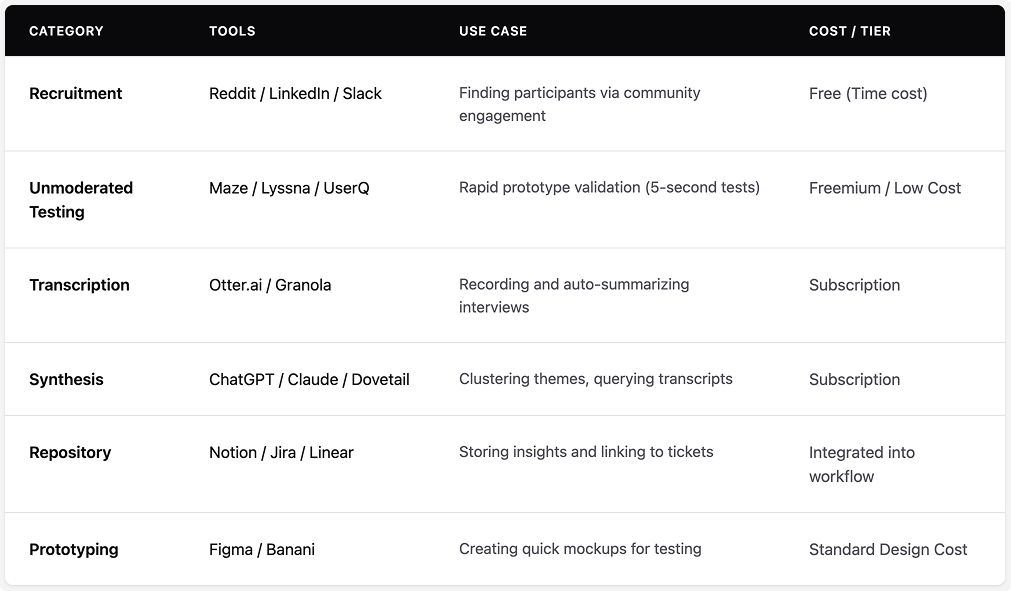
The most labor-intensive part of research is analyzing hours of video or audio. Tools like Otter.ai, Dovetail, and specialized wrappers (Granola, Looppanel) now automate this workflow.
- Real-Time Transcription
AI tools transcribe sessions in real-time, allowing the designer to focus on the user’s body language rather than scribbling notes. - Sentiment Analysis
NLP models scan transcripts to tag moments of frustration, delight, or confusion. While not perfect, these tags provide a heat map of the session, allowing the designer to jump directly to friction points. - Chat with Data (RAG): Earlier Retrieval-Augmented Generation (RAG) allows designers to upload 10 transcripts (now even more) and ask natural language questions
“What was the most common complaint about the signup flow?”. The AI retrieves specific quotes across all users to answer the question. This democratizes access.
A Product Manager (PM) can query the data without waiting for the designer to write a report.
The Controversy of Synthetic Users
AI agents simulating user personas have entered the market. These tools allow designers to test prototypes against AI agents trained to act like Angry Boomers or Tech-Savvy Teens.
- Strategic Use
These are useful for functional smoke tests (e.g., Does the agent get stuck in a loop?) and checking basic heuristic compliance. - Limitations
AI cannot simulate the emotional irrationality of a human purchasing decision or the environmental distractions of the real world. Synthetic users should be used to debug the flow, never to validate the value proposition or replace human contact.
The Tool Stack for the Founding Designer
Sense making, From Chaos to Clarity
In a startup, a research report that takes a week to write is useless. The synthesis must happen immediately. The goal is not to document everything, but to identify the signal amidst the noise.
The Rise of Continuous and Atomic Models
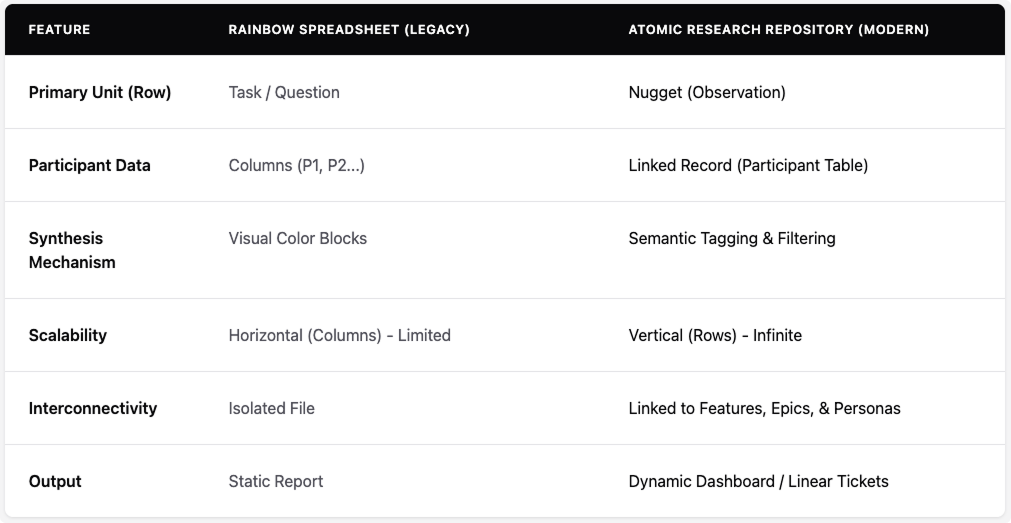
Atomic Research, a methodology formalized by Tomer Sharon and Daniel Pidcock, treats research data not as documents but as structured data points. It posits that research should be broken down into its smallest indivisible units (nuggets), which consist of an observation, evidence, and tags. This modular approach allows insights to be recombined and queried across different studies, effectively turning the research repository into a relational database rather than a file cabinet.
Simultaneously, the adoption of Continuous Discovery Habits, championed by Teresa Torres, has shifted the temporal cadence of research. Instead of large-batch studies, teams engage in weekly touchpoints with customers. This requires templates and tools that support rapid, lightweight entry and instant synthesis, rather than the heavy cognitive load associated with maintaining a massive Rainbow Spreadsheet. The integration of these frameworks into modern tooling, specifically relational databases like Airtable and Notion, and AI-enabled platforms like Dovetail and Looppanel, defines the current state.
The Relational Database Model
In an Atomic framework, the primary unit is the Nugget, a distinct piece of information.
This structural change necessitates a move from flat spreadsheets to relational tables (supported by tools like Airtable, Notion, or even advanced Excel data models). An effective Atomic Research template consists of three interconnected tables: Experiments, Observations (Facts), and Insights.
Download Template
The Opportunity Solution Tree (OST) as Data Structure
While the Opportunity Solution Tree is visually represented as a branching diagram, its operational management often occurs within a spreadsheet or database view, particularly for tracking progress and evidence. The OST framework connects Outcomes (Business Goals) to Opportunities (User Needs) and Solutions (Features).
Download Template
The Smart Database: Airtable and Notion
Airtable and Notion have emerged as the primary low-code alternatives to standard spreadsheets, offering the flexibility of a grid view with the power of relational databases.
Airtable
Airtable is favored for its robust relational capabilities and Interface features. It allows Research Operations (ReOps) teams to build custom dashboards for stakeholders.
- Advantage
It scales to handle thousands of records (nuggets) without performance degradation and supports complex formulas for calculating Evidence Scores. - Integration
It integrates natively with tools like Slack and Jira, allowing a High Severity tag in Airtable to automatically trigger a bug report in the engineering backlog.
Notion
Notion excels at combining unstructured data (long-form interview notes, images, embedded videos) with structured properties.
- Advantage
It serves as a unified workspace where the Research Plan, Script, Notes, and Synthesis live on a single page. Templates by creators like Odette Jansen demonstrate how Notion databases can be filtered to show My Open Research Tasks or Insights by Persona. - Wiki Functionality
Notion’s ability to link distinct databases allows for a Global Tag Database, ensuring that tags used in a marketing research project are consistent with those used in product research.
The Guerrilla Usability Scorecard
For founding designers and early-stage startups conducting Hallway Testing or Coffee Shop intercepts, the primary requirement is speed.
Target User
Founding Designers, Solo Researchers.
Platform
Google Forms -> Sheets.
The innovation here is the use of Conditional Formatting.
Download Template
Implementation, From Insight to Jira
Research that does not result in code is vanity. The transition from Insight to Engineering Ticket is the point of failure for many design teams. The founding designer must bridge this gap by integrating research directly into the engineering workflow.
The Atomic Research Repository
Don’t bury insights in PDF reports that no one reads. Use an Atomic approach in tools like Notion, Linear, or Jira Product Discovery. This method breaks research down into its smallest distinct units.
The Structure of an Atom:
- Nugget (Fact)
Users are confused by the Archive icon. - Evidence (Source)
Link to Video Clip P3 at 04:20 and P4 at 02:10. - Insight (Theory)
The iconography is culturally ambiguous or resembles a Delete action. - Recommendation (Action)
Replace icon with text label Archive. - Ticket (Execution)
Link to OR.
By linking the Engineering Ticket directly to the Evidence, the designer protects the decision. When an engineer asks, Why are we changing this icon?, the link to the video clip provides the answer. The user speaks for themselves, removing the designer’s ego from the equation.
Download Template
The Engineering Handshake
The concept of a Handoff is obsolete in agile startups. It implies a one-time transfer of responsibility. It should be a Handshake a continuous dialogue.
Involving Engineers Early
The best way to ensure implementation is to involve engineers in the observation phase. If a developer watches a user struggle with their code live, they will fix it faster than if they are assigned a ticket telling them to fix it. Empathy drives code quality.
The Watch Party
Host a 30-minute session where the team watches a highlight reel of the struggle moments. This creates a shared reality.
Loom Videos over Spec Docs
Instead of writing a long specification document, record a 2-minute Loom video walking through the research findings and explaining why the design changed.
- Script: Hey team, in our testing today, 3 users failed to find the button. Here is the clip. Because of this, I’ve moved the button here. Here are the specs.
- Engineers consume video faster than text, and the auditory context reduces misinterpretation.
Prioritization Frameworks (RICE)
Startups have infinite ideas and finite time. Research helps populate the RICE score to prioritize the backlog objectively.
- Reach: How many users does this affect? (Data from analytics).
- Impact: How big is the pain? (Data from Guerrilla Research e.g., It was a showstopper).
- Confidence: How sure are we? (Guerrilla research specifically boosts this score).
- Effort: Engineering estimates.
By assigning a Confidence score based on research, the team can justify betting big on validated features while killing features that tested poorly, effectively de-risking the roadmap.
Ethics, Consent, and Safety
Guerrilla research is informal, but it cannot be unethical. Privacy laws (GDPR, CCPA) apply even in a coffee shop. The founding designer must be a steward of user data.
Informed Consent on the Fly
You cannot hand a 5-page legal document to a stranger in a park. It destroys the rapport. Instead, use a Micro-Consent form (digital on an iPad or a half-sheet of paper).
Key Elements of Micro-Consent
- Purpose: We are recording this for internal product improvement.
- Privacy: It will not be shared publicly or on social media.
- Withdrawal: You can stop at any time.
- Verbal Confirmation: If recording audio/video, get the consent on the recording at the start. Do I have your permission to record this session?. This creates an audit trail.
PII and AI Tools
Be extremely cautious when uploading recordings to AI tools (Otter/ChatGPT). Ensure that Personally Identifiable Information (PII) like names, emails, addresses, or medical data is stripped sanitized or that the tool is enterprise-grade and SOC2 compliant. Never upload raw customer databases to public LLMs to generate insights; this is a data breach waiting to happen.
Founding Designer’s Cheat Sheets
Note: Copy, paste, and adapt these templates for your Notion/Excel/Word.
View them on notion
Conclusion, The Culture of Curiosity
For the founding designer, guerrilla research is not a phase of the project. It is a way of life. It is the persistent refusal to accept assumptions as facts. By integrating these rapid, low-cost, and high-velocity methods into the daily workflow, the designer creates a culture of curiosity within the startup.
The tools will change, AI will become smarter, prototyping will become faster, but the core dynamic remains the same. The designer who gets out of the building and talks to humans will always out-build the designer who stays inside and polishes pixels.
The goal is not a perfect report. The goal is a product that fits the market.
Final Directives
- Scope Down: Test one thing at a time.
- Recruit creatively: Use the whole internet.
- Synthesize Visually: Use Rainbow Spreadsheets.
- Leverage AI: Use it for speed, not empathy.
- Link to Code: Insights must become tickets.
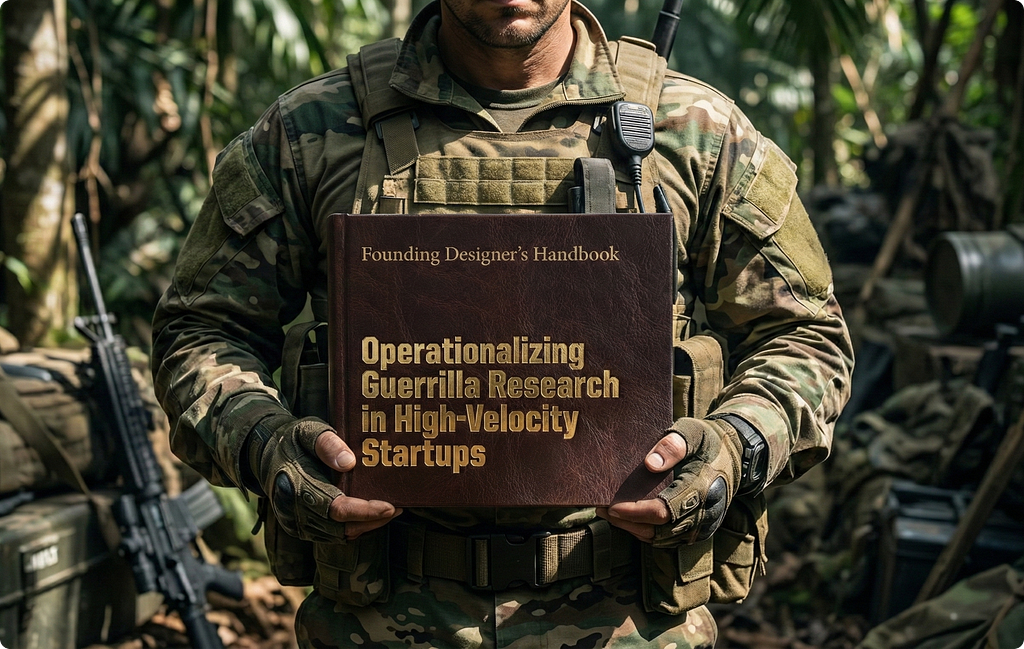
Founding Designer’s Handbook: Operationalizing Guerrilla Research in High-Velocity Startups was originally published in Bootcamp on Medium, where people are continuing the conversation by highlighting and responding to this story.