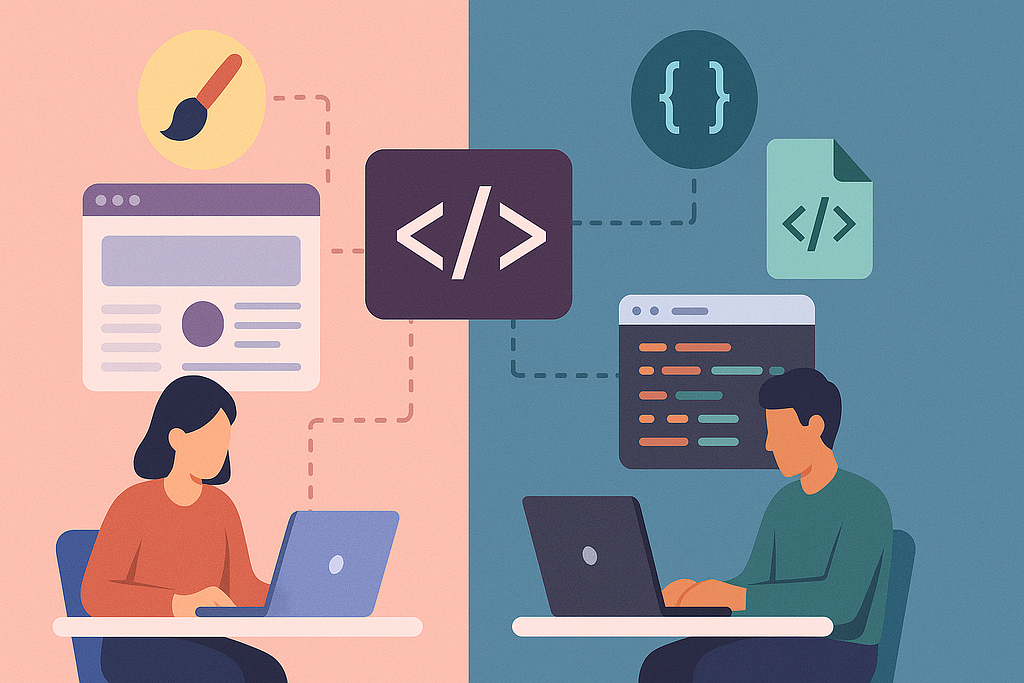
Design and development have always existed together, but simultaneously. All major companies have designers who design screens initially and developers who create them afterwards. But this practice is changing now.
As a designer, I’m always looking around at how our tools and process shift. Right now, we are experiencing a massive shift on how we work: the emergence of “code-first design platforms” like Subframe and UXPin. These platforms do not simply create static mockups. They connect what we design to the code that powers actual products.
This shift called Code-First Design isn’t just a tool change, its altering the smartest way to ship better, faster, and more consistent products.
Why the Old Way Isn’t Enough
With the older method of working, product managers determine what features go in and what needs to be created. Designers take those specifics and turn them into mockups or prototypes that illustrate how users will use the product. Once the designs are complete, developers then take those images and translate them into actual working code.
While this process has been utilized for decades, it tends to create delays and miscommunications between what the design was going to do and what the end result is.
This method of working worked for years but previously caused issues. There were misunderstandings between teams regarding how certain interactions had to be, leading to confusion in development. There was a lot of going back and forth over tiny visual details and user flows, which held things back. Because of this, time was wasted resolving issues once development had begun, which lessened the efficiency and made the process frustrating for all.
Is the Three-Legged Stool Model Ending?
For a few years, the teams employed a clean way of working known as the “Three-Legged Stool”. What that meant was that the engineers, product managers, and designers all collaborated to create amazing products. The designers created mockups, the engineers constructed them, and the PMs ensured that everything was shipped within time.
But in modern high-velocity product teams, these hard-and-fast role divides actually become a liability. Increasingly, I’ve found that it’s about getting along as a team, rather than being different. Subframe is one of the technologies that shatters these silos using a shared language-code-that all members of the team can use and interpret. It’s this shift that fosters improved teamwork and shared accountability, rather than role hand-offs.
The Promise and Peril of Code-First Design
Code-First Design has some very real strengths and actual challenges. On the one hand, it enables quicker development by minimizing communication problems between teams, makes it more accurate by coding in live environments, makes it more conducive to shared responsibility between developers and designers, and allows for more, reusable design systems. But there are risks, too. Designers will be stifled in their creativity if they only work with pre-coded components, and visual quality will suffer if speed is given more importance than detail. Not all teams possess the correct tools or experience to make this workflow efficient, and burnout is likely if designers are required to code without proper support. That is why Code-First Design must never be enforced. It is optimal when both design creativity and technical structure are treated equally.
Why This Matters More Now
With the likes of Meta’s Large Concept Models (LCM), GitHub Copilot, Codex, and so many others, we are now at an era where AI can write or even propose code. This shifts the speed and scale at which we can construct things.
Designers must be kept abreast. That involves being more engaged with the code, developing in actual environments, and thinking in terms of systems, not screens.
What Designers Can Do
Designers do not need to be professional coders, but it is beneficial if they understand the fundamentals of coding, how components, layout systems, and state work. This allows them to design with actual constraints in their heads. Having live tools such as UXPin, Subframe, or Storybook to collaborate with allows designers to view how their concepts function in actual situations, which eliminates surprises in development. Utilizing design tokens is also critical because it ensures the style is uniform from design to code, making collaboration simpler and the end product better.
What Developers Can Do
Developers are responsible for making Code-First Design work. They create reusable and flexible blocks of code, which enable designers to try new ideas without rebuilding from the ground up. Early collaboration is vital, working in tandem and sharing code and feedback while designing keeps everyone on the same page and facilitates quick decision-making. Most importantly, paying attention to design details like spacing, color, and animation keeps the product gorgeous and provides an exceptional user experience. These details are not add-ons. They are what provide a sense of polish and quality to a product.
Final Thoughts
Code-First Design is not about designers becoming engineers or developers learning Figma. It is about shattering the barrier between both.
It is about producing higher-quality products sooner, where design is not an afterthought, but essential to the foundation. With the proper tools, mindset, and collaboration, Code-First Design has the potential to empower teams to deliver with less waste, greater clarity, and better outcomes.